Area Locations

Areas

The Castle Hill Basin is made up of nine areas as described below. There are three different land owners / access arrangements - please read about each area before you visit.

Part of the Kura Tawhiti Reserve, Quantum Field is the most popular field in the basin. With about 1500 graded boulder problems to keep you entertained and an easy 10 minute stroll from the carpark, it is guaranteed to be a good day. There are plenty of established route climbs as well, but further bolting is prohibited.

This is the land of the mantle topout, on the most frictionless rock.

Part of Kura Tawhiti Reserve.

The first set of boulders on your left as you walk in from the car park. A close second most popular field, Spittle Hill has stacks of boulder problems including many interesting moderates. Polished holds are rife here unfortunately, due to ease of access and popularity. It's best not to climb on polished rock, please consider finding a different climb. There are many options!

Wuthering Heights is the silhouetted line of boulders above Quantum Field that you cannot miss. Part of the Kura Tawhiti Reserve. With a concentrated number of 2 and 3 star problems, and featuring at least 100+ must-do problems, it is well worth the short sharp hike up the hill. Follow the obvious track around the bottom of Quantum Field, past Dark Castle, and up the left side of the boulders.

Just north of Rambandit Valley, Dark Castle features more routes than boulder problems. Some classic lines include the 3-star Rambandit crack, and Eric Talmadge’s Angel of Pain.

A special part of Kura Tawhiti Reserve that has predator fencing - please shut the gates!

Please be very careful of the fauna and flora if you are venturing in the area. There are many extremely rare plants in the area (like the Castle Hill Buttercup ). We would suggest only climbing on boulders well clear of plants around the south and west of the field. Best to stay away from the more fragile area to the north.

We are privileged to climb here, please follow guidelines set by Flock Hill Station here:  *Safety Notice*

Please be extra attentive to the fact that Flock Hill Station is expanding its operations in this area, especially in the Valley around the picnic table. Please act responsibly and kindly, and ensure to uphold the climbers' good reputation!

Dry Valley has become the forgotten area in recent years because the access has changed - now climbers must park at the Flock Hill carpark and walk back to Dry Valley, approx 4km+. Pre-2005 it was a quick jaunt from Cave Stream to the boulders and the area was bustling with activity (well, comparatively). Now it is hard to even find boulder problems that don’t require cleaning.

The boulders here have a ‘Quantum Field blankness’ to them which makes the lines that do exist stand out all the more.

We are privileged to climb here, please follow guidelines set by Flock Hill Station here:  *Safety Notice*

Flock Hill is the premier bouldering area in the Basin. With its huge twisted forms and water-worn limestone boulders, Flock Hill offers perfect terrain for proud modern bouldering problems. Although people have been climbing here for over 40 years, Flock Hill is still under-developed.

With a long approach to ward off the masses and lichen covering past climbers’ test pieces, Flock Hill has always been an area for adventure. The names and grades of problems are passed around like Chinese whispers from climber to climber, so only a handful of locals have a grasp of who has climbed what problems and where all the established classics are.

The Cave Stream Scenic Reserve is home to one of the most outstanding natural features in the Canterbury region - a 594 metre long cave which visitors can walk through (please take note of the warning signs about entering the cave - it has claimed lives).

There are a handful of boulders just south of the cave entrance and two nice boulders next to the river by the cave exit.

This is a small field, but somehow a few excellent problems have been cleaned & climbed. There are a lot of special and rare native plants among the boulders and utmost care must be taken not to damage any flora or fauna. The topography doesn't really lend itself to good rock climbing.

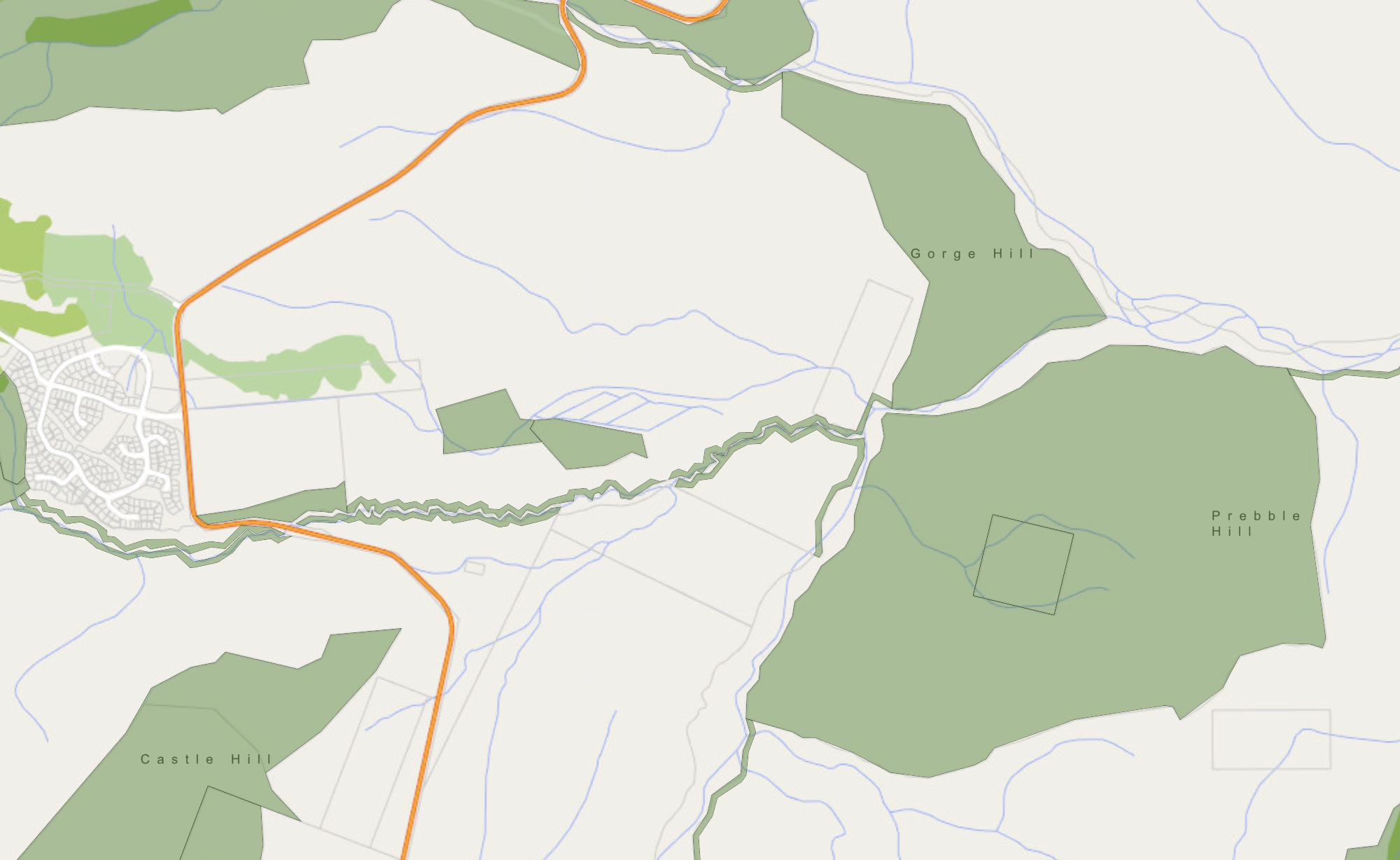
Part of the Conservation Area - Castle Hill (s.25 - Stewardship Area) – a conservation category which provides protection based on the natural and historic values of the land. Gorge Hill and Prebble Hill were once part of Castle Hill Station but were purchased by the Nature Heritage Fund and returned to the Crown. Another piece of public conservation land within this location is Scenic Reserve Prebble Hill (an 8 hectare section within the boulders).

Prebble Hill (‘Teapot’) and Gorge Hill are both closed to all visitors from 14 Oct – 1 Dec each year. Castle Hill Station has a grazing lease on both Hills which allows for a closure for lambing. Public access is allowed outside of this time frame. Please be mindful that it is both a working farm and a conservation area.

Access

Official access point to both Prebble Hill (‘Teapot’) and Gorge Hill is via the Cave Stream Scenic Reserve. The track is vague and may change seasonally due to weather events and river adaptations. Involves crossing the river at least twice. Do not cross if it's running swift or high, you're responsible for your own safety. Best to be shown precise route from other climbers.

An alternate route is via the Porter River marginal strip, an approx 4km+ walk along riverbed from rest area where SH73 crosses Porter River. Involves at least two river crossings. Status of track unknown. It is not recommended to use this route.

Please do not walk in via the Thomas River or along the terrace above it. The Castle Hill Station farm managers, Selwyn District Council and DOC have all agreed that this route is not practicable and requested that climbers do not use this access route. Please respect this decision. It is important that climbers act responsibly and foster goodwill with both farm managers and local authorities to ensure long term access is viable.

Check https://www.doc.govt.nz/map/index.html for details of boundaries and marginal strips.

doc land

Part of the Conservation Area - Castle Hill (s.25 - Stewardship Area) – a conservation category which provides protection based on the natural and historic values of the land. Gorge Hill and Prebble Hill were once part of Castle Hill Station but were purchased by the Nature Heritage Fund and returned to the Crown. Another piece of public conservation land within this location is Scenic Reserve Prebble Hill (an 8 hectare section within the boulders).

Prebble Hill (‘Teapot’) and Gorge Hill are both closed to all visitors from 14 Oct – 1 Dec each year. Castle Hill Station has a grazing lease on both Hills which allows for a closure for lambing. Public access is allowed outside of this time frame. Please be mindful that it is both a working farm and a conservation area.

Access

Official access point to both Prebble Hill (‘Teapot’) and Gorge Hill is via the Cave Stream Scenic Reserve. The track is vague and may change seasonally due to weather events and river adaptations. Involves crossing the river at least twice. Do not cross if it's running swift or high, you're responsible for your own safety. Best to be shown precise route from other climbers.

An alternate route is via the Porter River marginal strip, an approx 4km+ walk along riverbed from rest area where SH73 crosses Porter River. Involves at least two river crossings. Status of track unknown. It is not recommended to use this route.

Please do not walk in via the Thomas River or along the terrace above it. The Castle Hill Station farm managers, Selwyn District Council and DOC have all agreed that this route is not practicable and requested that climbers do not use this access route. Please respect this decision. It is important that climbers act responsibly and foster goodwill with both farm managers and local authorities to ensure long term access is viable.

Check https://www.doc.govt.nz/map/index.html for details of boundaries and marginal strips.

doc land